
Bathroom wall panels vs tiles: an honest comparison
Bathroom wall panels vs tiles compared honestly: fitting time, cleaning, mould, durability, cost and where tiles still win, before you choose.
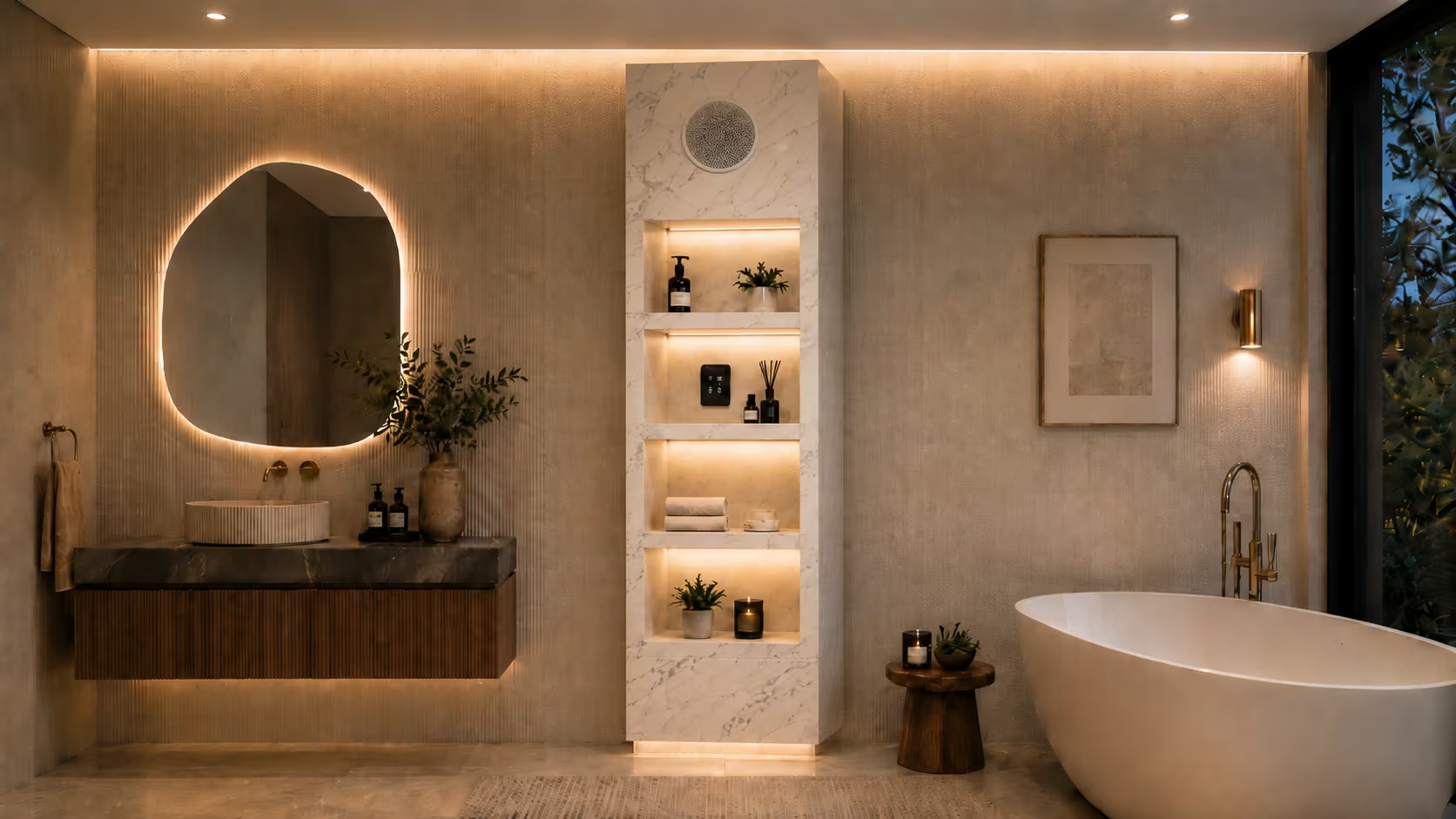
Almost everyone who asks about bathroom wall panels has the same reason: they are tired of cleaning grout. That is a good reason. It is not the only thing to weigh up, and there are bathrooms where tiles are still the better answer.
We sell wall panels and we do not sell tiles, so read this knowing that. We have tried to be fair to both.
What a bathroom wall panel actually is
The panels made for showers and wet rooms are mostly SPC, which stands for stone plastic composite: a rigid core of powdered stone bound with PVC, with a printed decorative layer and a hard wear coat on top. The stone makes it dense and flat; the PVC makes it waterproof right through, so a cut edge or a drilled hole does not let water into the core.
Cheaper PVC cladding does the same job in a thinner, lighter, hollow form. It is fine on a ceiling or a cloakroom wall, but it dents more easily and shows any unevenness in the wall behind it. Mineral boards such as our Carbon Rock Board are a different product again: excellent on feature walls and splashbacks with a moisture-resistant specification, but not what we would put inside a shower enclosure.
Fitting time
This is where panels win clearly. Tiling a bathroom properly means preparing or boarding the walls, tiling, leaving the adhesive to set, grouting and then sealing, which in practice is several days of a room you cannot use.
A large panel covers almost three square metres in one piece, fixes with adhesive or click-lock joints, and needs no grout and no drying time. Most bathrooms are panelled in a day, and the shower can usually be used once the silicone has cured. Where the existing tiles are sound, the panels can often go straight over them, which saves the mess of stripping the walls.
Cleaning and mould
Grout is porous. However well it is sealed, it takes in water and soap, and in a steamy bathroom that is where the black mould starts. A panelled wall has a joint every 1.2 metres rather than every few centimetres, and the face is non-porous, so a wipe with a cloth is the whole cleaning routine.
The silicone at the bath and the shower tray is the exception. It is there on a tiled wall too, it can still discolour, and it still needs renewing every few years. Neither panels nor tiles fix a bathroom with a weak extractor fan; that is the first thing to sort out either way.
Where tiles still win
Floors, for a start. Wall panels are made for walls; a bathroom floor needs tiles, vinyl or another floor finish.
Durability against knocks. Porcelain is very hard. A panel can be scratched by something sharp or dented by a heavy impact, and while a damaged panel can be replaced, it is a whole panel rather than one tile.
Pattern and texture. If you want metro tiles, a herringbone, a zellige finish or a mosaic niche, that look only really comes from tiles. Panels are at their best as large, calm, continuous surfaces: marble, stone, concrete and plain colours.
And the feel. A panel looks like marble. It does not feel cold and heavy like a porcelain slab, and anyone who tells you otherwise is selling something.
Cost
Tiles themselves range from a few pounds a square metre to hundreds, so comparing materials alone is meaningless. The difference is mostly labour. Tiling is skilled, slow work; panelling is quicker and needs fewer trades. For most bathrooms, a panelled wall costs less fitted than a well-tiled one of a similar look, and the gap widens the more of the room you cover.
The details that make or break a panelled bathroom
Seal every edge. The bath, the shower tray, the window reveal and the floor are where water finds its way behind a panel. A continuous bead of sanitary silicone, run after the panels are fixed, is what keeps the wall dry.
Plan the joints. Keep them out of the direct spray of the shower head where you can, and set them out symmetrically on the wall people see first.
Drill fittings carefully. Holes for the shower valve, the riser rail and the taps should be cut cleanly and sealed. A cheap shower rail screwed through a panel with no sealant is the most common cause of a leak.
Use the trims. Matching corner and edge trims hide the cut edges and make the finish look intended. And leave the electrics to an electrician: a lit shelf or a shaver socket in a bathroom has to suit the zone it sits in.
What we supply
Our SPC waterproof wall panels are 1220 by 2440mm, in 4 or 6mm, waterproof from core to surface, anti-mould and easy to clean, for bathrooms, wet rooms, shower surrounds and kitchens. For a statement wall outside the shower, Carbon Rock Board in a marble or stone finish gives the same look as the living room, with a moisture-resistant specification.
And if the bathroom needs storage as well as a finish, our single modules put lit, recessed shelving for towels and bottles into the wall itself, with the lighting chosen for the bathroom zone it sits in.
Common questions
- Are bathroom wall panels better than tiles?
- They are quicker to fit and much easier to keep clean, because there is no grout. Tiles are still better on floors, harder-wearing against knocks, and the right choice if you want a small-format pattern such as metro tiles.
- Can you put bathroom wall panels over tiles?
- Often, yes, if the existing tiles are sound, flat and firmly stuck. Remove any loose or hollow-sounding tiles first, and remember the panel adds thickness at window reveals, the bath edge and around fittings.
- Do bathroom wall panels go mouldy?
- The face of a good waterproof panel does not, because it is non-porous with almost no joints. The silicone seals at the bath and shower tray can, as in any bathroom, so they still need cleaning and occasionally renewing. Good extraction matters with either.
- Are bathroom wall panels waterproof?
- SPC panels are waterproof all the way through, not just on the face. The weak points are the joints and the edges, so the seals at the bath, the tray and around every fitting are what keep water out of the wall.
- What size are bathroom wall panels?
- Our SPC waterproof panels are 1220 by 2440mm, in 4 or 6mm thickness, so one panel covers almost three square metres of wall. They fix with adhesive or click-lock joints.
Carbon Rock Board: every finish, priced by the board
SPC waterproof wall panels for bathrooms and showers
Written for customers in Glasgow, Edinburgh, Scotland and across the UK.