
How high should a TV be mounted? Heights by room
How high to mount a TV in a living room, a bedroom or above a fire: the eye-level rule, heights for 55 to 75-inch screens and when to tilt it.
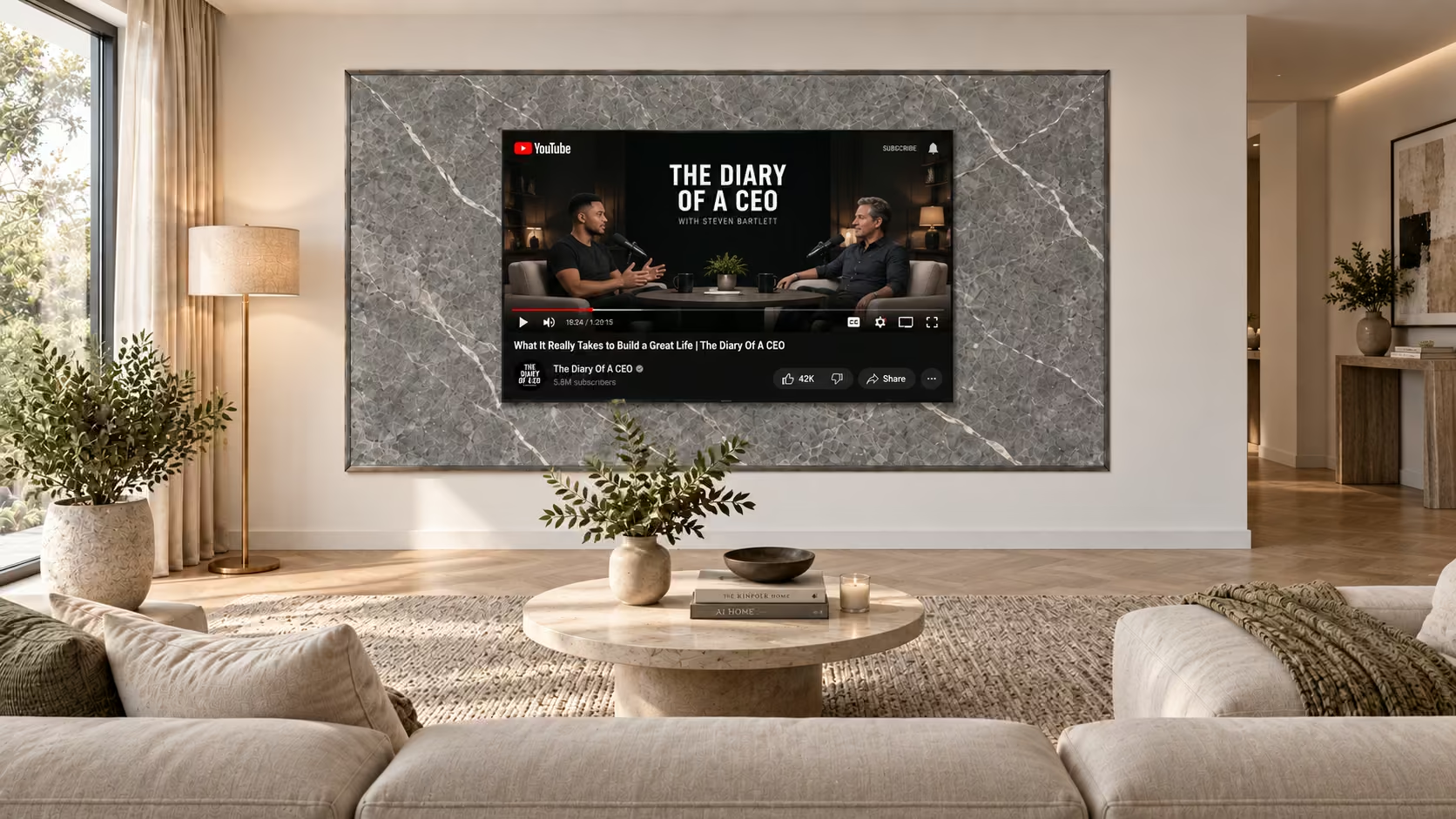
Most wall-mounted televisions are hung too high. It happens for good reasons: the wall looks better with the screen centred on it, there is a fireplace in the way, or the bracket went where the fixings were easiest. Then you spend the next ten years watching with your chin up.
Here is how to get the height right before you drill, in a living room, a bedroom and above a fire.
The rule: the centre of the screen at seated eye level
Sit where you normally watch, look straight ahead, and have someone mark the wall at your eye level. That mark is where the middle of the screen should go. On most sofas it lands somewhere between 100 and 110cm from the floor, but a low modular sofa and an upright armchair can be 15cm apart, so measure your own.
A few degrees of looking up is fine. What causes the stiff neck is a screen whose centre is half a metre above your eye line, watched for a whole film. If you have to choose, err low rather than high.
Heights for common TV sizes
Screen sizes are measured on the diagonal, so it helps to know the actual height. A 55-inch television is about 69cm tall, a 65-inch about 81cm and a 75-inch about 93cm.
With the centre of the screen at 105cm, that puts the bottom edge at about 70cm for a 55-inch, 65cm for a 65-inch and 58cm for a 75-inch. Those heights leave room for a low media unit or a soundbar underneath, which is no coincidence: it is the layout the furniture is designed around.
Bracket plates are rarely in the centre of the television's back, so measure from the screen's mounting holes to its bottom edge before you mark the wall for the bracket.
Viewing distance decides the size, not the wall
For a 4K television, sit roughly one to one and a half times the screen's diagonal away. That is about 1.4 to 2.1 metres for a 55-inch, 1.65 to 2.5 metres for a 65-inch and 1.9 to 2.85 metres for a 75-inch. Further than that, the extra resolution is lost on you. Closer, you start turning your head to follow the action.
Measure from the front of the sofa to the wall before you choose a size. A bigger screen hung at the right height is better than a smaller one hung too high to make it look in proportion.
Above a fire
This is the hard one, because the fire pushes the television up. Three things help. First, choose a fire that vents its heat from the front rather than the top: a top-venting fire needs a larger gap below the screen, which costs you height. Second, set the fire low in the wall rather than at traditional mantel height. Third, if the centre of the screen still ends up well above eye level, use a bracket that tilts it down towards the sofa.
Our guide to choosing an electric fire for a media wall covers the clearances in more detail. The short version is to put the television at the right height first and fit the fire into the space below it, not the other way round.
In a bedroom
You watch a bedroom television propped up against the headboard, so your eye line is higher than on a sofa and you are usually leaning back. Sit up in bed, mark your eye level on the opposite wall, and mount the screen with its centre at that mark or slightly above it with a gentle downward tilt.
Keep the screen square to the bed. A television mounted to one side for the sake of a window or a wardrobe is one you will watch with your head turned, and in bed that is worse than on a sofa.
In a kitchen or dining room
Decide where you will actually watch it from. If it is the dining table, measure seated eye level at the table, which is higher than on a sofa because dining chairs are taller. If it is mostly on in the background while you cook, a standing eye line is fine, but tilt it towards the table so the screen is still readable when you sit down.
What the bracket fixes into
Check the bracket's weight rating against the television, and that it matches the VESA hole pattern on the back. Then fix it into something solid: masonry with the right anchors, or timber studs behind plasterboard. Plasterboard on its own is not a fixing, and nor is a decorative wall panel, which is why the panels in our feature walls are cut out for the bracket so it sits on the wall behind.
In our media walls, the reinforcement for the bracket is built into the module frame in the factory, at the height agreed before it is made.
We supply two brackets. The standard extendable bracket, which pulls out and swivels, is £80.00 plus VAT. The motorised smart TV bracket, on a swing arm you move from a remote or your phone, is £185.00 plus VAT. Installation is not included in either price.
Try it before you drill
Cut a sheet of cardboard to the size of the screen, or mark its outline with masking tape, and leave it on the wall for a couple of evenings. Watch from the sofa. If you find yourself looking up at it, lower it. It is the cheapest way to get the most-looked-at thing in the room right first time.
Common questions
- How high should a TV be mounted on the wall?
- Put the centre of the screen at your eye level when you are sitting where you watch. On a typical sofa that is around 100 to 110cm from the floor, but measure your own: sofas vary by more than you would think.
- How high should a 65-inch TV be mounted?
- A 65-inch screen is about 81cm tall. With its centre at 105cm, the bottom edge sits about 65cm from the floor, which leaves room for a low media unit or soundbar beneath.
- How high should a TV be above a fireplace?
- As low as the fire's installation instructions allow. If that puts the centre of the screen well above eye level, use a tilting bracket to angle it down towards the sofa, and choose a fire that vents from the front so the TV can sit closer to it.
- How high should a TV be in a bedroom?
- Higher than in a living room, because you watch it propped up in bed. Sit up against the headboard, mark your eye level on the opposite wall, and angle the screen down slightly with a tilting bracket.
- How far should you sit from a TV?
- For a 4K television, roughly one to one and a half times the screen's diagonal. That is about 1.4 to 2.1 metres for a 55-inch screen and 1.65 to 2.5 metres for a 65-inch.
The motorised smart TV bracket, priced online
Written for customers in Glasgow, Edinburgh, Scotland and across the UK.